Wow, one post a year. What a lousy blog.
I've found some "interesting" "music" on archive.org called noise art. If you take a listen, you'll understand the quotes. It stretches the definition of music, and most people would find it assaulting/insulting to their aural environment. I know for sure many people who would turn to me after listening and say, "Come on Ted, be serious. You can't actually like this stuff."
I will be serious. So I smirked a little when I heard it first. Ha ha, create a sound that is as unappealing as possible and try to pass it off as music. But then I listened to it with an open mind and was amazed. It is trance-like, a real right brain experience. I felt the same euphoria that I've felt in the presence of a precisely manicured symphonic orchestra, or the unity of a well-trained choir. It was beautiful and intoxicating. And it was cleansing. It opened my mind like the Ives' exercise to sing and play a half step apart. Try it, play Yankee Doodle in C while singing it in D-flat.
So how could noise be beautiful? How is it possible that the polar opposite of historical definition of beauty and consonance can be also found beautiful? Consider the hair of a woman. It swings and falls in a united yet unorganized way. There is something noisy about it. Most people would agree that tying up the hair into a tight, controlled bun would be not so attractive as the free, complicated pattern that it would create if it were loose. A computer animation of hair, or water, or even dust would be insipid without randomness or apparent random elements included.
Random can be beautiful. Noise can be art.
1.18.2009

1.16.2008
child-like creativity
So it has been awhile, I know. One of the requirements of a class that I'm teaching is the students must create and post to their blogs often. I figured I might as well set a good example, or at least a better example than what I have so far.
I was hit with an epiphany last night. I was looking through my old college stuff and found a sound design project I had done. The remarks from the professor declared how unique and creative the sounds were, and I remember how much I liked them myself, but last night I wondered if I would create the same thing now, given who I am and where I am in my life today.
The thing that struck me the most is how naive and almost childish my thinking was. When I sit down to compose, I feel tense, as if I need to hammer out this monumental thing, whereas back then I didn't seem to care so much. Get the project done, have fun, do something cool. That's all, no real pressure.
We've been listening to They Might Be Giants in our household lately. Now that they've released some kid's CD's the whole family likes them (instead of just me). They inject an obvious character into their songs. Each song has an appealing amateurish feel to it, similar to the style of Strong Bad's email. It is as if each song was improvised, there is no delusions of grandeur, no pretentiousness, just fun, creative, goofing around. It is very child-like and refreshing.
I was hit with an epiphany last night. I was looking through my old college stuff and found a sound design project I had done. The remarks from the professor declared how unique and creative the sounds were, and I remember how much I liked them myself, but last night I wondered if I would create the same thing now, given who I am and where I am in my life today.
The thing that struck me the most is how naive and almost childish my thinking was. When I sit down to compose, I feel tense, as if I need to hammer out this monumental thing, whereas back then I didn't seem to care so much. Get the project done, have fun, do something cool. That's all, no real pressure.
We've been listening to They Might Be Giants in our household lately. Now that they've released some kid's CD's the whole family likes them (instead of just me). They inject an obvious character into their songs. Each song has an appealing amateurish feel to it, similar to the style of Strong Bad's email. It is as if each song was improvised, there is no delusions of grandeur, no pretentiousness, just fun, creative, goofing around. It is very child-like and refreshing.
2.26.2007
Calm down everyone, I'm still alive....
You know its time to post something new to your blog when people start calling up and offering their condolences to my wife..
Your wait, however, has not been in vain. Here is my latest creation, available for a limited time only for you to listen to in its entirety: Twist of Fate.
It took me about a year to put this together, but most of that time was spent starting, stopping, starting over again, throwing it away, coming back to it, etc..... (sadly, this is my standard composition procedure)
Also, it took me the last 4 months to come up with a title, and I'm still not sure about the one I gave it. So, I leave it to you to leave a comment with your suggestions for a title. I'd kind of like to have something that represents the way my life has meandered in wildly different directions in the last couple of years. But I am open to anything.
Your wait, however, has not been in vain. Here is my latest creation, available for a limited time only for you to listen to in its entirety: Twist of Fate.
It took me about a year to put this together, but most of that time was spent starting, stopping, starting over again, throwing it away, coming back to it, etc..... (sadly, this is my standard composition procedure)
Also, it took me the last 4 months to come up with a title, and I'm still not sure about the one I gave it. So, I leave it to you to leave a comment with your suggestions for a title. I'd kind of like to have something that represents the way my life has meandered in wildly different directions in the last couple of years. But I am open to anything.
10.19.2006
Doomed to repeat
In a class I showed the engraving video that has made its way around the music blogs lately. If you have a broadband connection you can see it here:
Part way through (and I'm serious here) a student said, "Wait, haven't they been using Finale since like the 19th century?"
I performed a sort of stuttering combination of sentence beginnings without any endings, "They uh, " "No um..." "What do you..." "Finale wasn't really..." Finally another student saved me by saying something like, "they didn't even have computers back then you idiot."
Now I'm pretty sure he realized how dumb his question was almost as soon as he uttered it, but I guess it is a common mistake all of us tend to make. That is, the impression that nothing existed before you were born. For instance, the 60's and the Civil Rights movement seems like history to me, and the cold war is something I barely know anything about. Why? Because the only people that would have told me, wouldn't have realized that I didn't already know. I can imagine myself sitting in a class at some point and blurting out, "Haven't we been traveling to the moon for like the last hundred years?" I imagine the previous generation knew little about the Great Depression, and the earlier one couldn't imagine a world without automobiles. Things are only changing faster and faster. Kids can't imagine a time before the internet, soon the time before cell phones will be history. You know, when I was a kid, Cars had wheels that were always on the ground. And we had to drive them ourselves!
Part way through (and I'm serious here) a student said, "Wait, haven't they been using Finale since like the 19th century?"
I performed a sort of stuttering combination of sentence beginnings without any endings, "They uh, " "No um..." "What do you..." "Finale wasn't really..." Finally another student saved me by saying something like, "they didn't even have computers back then you idiot."
Now I'm pretty sure he realized how dumb his question was almost as soon as he uttered it, but I guess it is a common mistake all of us tend to make. That is, the impression that nothing existed before you were born. For instance, the 60's and the Civil Rights movement seems like history to me, and the cold war is something I barely know anything about. Why? Because the only people that would have told me, wouldn't have realized that I didn't already know. I can imagine myself sitting in a class at some point and blurting out, "Haven't we been traveling to the moon for like the last hundred years?" I imagine the previous generation knew little about the Great Depression, and the earlier one couldn't imagine a world without automobiles. Things are only changing faster and faster. Kids can't imagine a time before the internet, soon the time before cell phones will be history. You know, when I was a kid, Cars had wheels that were always on the ground. And we had to drive them ourselves!
9.18.2006
e-biquitous
Now that I'm back in the college atmosphere, I'm interested to see the differences of today's students. I'm not claiming that I graduated all that long ago, but the changes are still striking.
People are connected.
Yesterday I was walking back to my parking spot (my quarter-mile exercise for the day) and I followed behind a couple holding hands. Aw, how sweet, good ol' college sweethearts. But when I got closer, I found they were each talking on cell phones. What?! Now who could you possibly need to be talking to while walking with your darling? Is it your high school buddy, or maybe your roommate? jeese.
Every day is the same; everyone I pass has a cell phone, iPod, or some other electronic device in hand. It is uncanny, like some kind of trippy Motorola commercial or something.
The other way students are connected is through IM. I have a few friends that I keep in touch with IM, but my buddy list is woefully small compared to most of the students. I don't understand where they find 50-60 friends to populate their buddy list. They obviously pass their screen name out without a care, whereas I've noticed people my age are a little wary of giving it out. Personally, I believe IM will become much more pervasive and useful in the future. I've already used it effectively in grad school. I posted my screen name on the computer in the lab and I had a number of times when a student would IM me at 10:00pm to say the MIDI is not working, or ask to have me walk them through a complicated process. I'm looking forward to the day when an IM device is embedded in everyone and we evolve into a race that speaks very little out loud. That way, when I zone out when people are talking to me, I will be able to later review everything they say in my cache browser.
See, it's not that I have a problem paying attention, it's just that I'm ahead of the technology.
People are connected.
Yesterday I was walking back to my parking spot (my quarter-mile exercise for the day) and I followed behind a couple holding hands. Aw, how sweet, good ol' college sweethearts. But when I got closer, I found they were each talking on cell phones. What?! Now who could you possibly need to be talking to while walking with your darling? Is it your high school buddy, or maybe your roommate? jeese.
Every day is the same; everyone I pass has a cell phone, iPod, or some other electronic device in hand. It is uncanny, like some kind of trippy Motorola commercial or something.
The other way students are connected is through IM. I have a few friends that I keep in touch with IM, but my buddy list is woefully small compared to most of the students. I don't understand where they find 50-60 friends to populate their buddy list. They obviously pass their screen name out without a care, whereas I've noticed people my age are a little wary of giving it out. Personally, I believe IM will become much more pervasive and useful in the future. I've already used it effectively in grad school. I posted my screen name on the computer in the lab and I had a number of times when a student would IM me at 10:00pm to say the MIDI is not working, or ask to have me walk them through a complicated process. I'm looking forward to the day when an IM device is embedded in everyone and we evolve into a race that speaks very little out loud. That way, when I zone out when people are talking to me, I will be able to later review everything they say in my cache browser.
See, it's not that I have a problem paying attention, it's just that I'm ahead of the technology.
9.11.2006
A Puzzle for Finale geeks
I assigned the second movement to Francis Poulenc's Mouvement Perpétual to my Computer and Music students last week. The piece is simple for the most part until you get to the last measure:
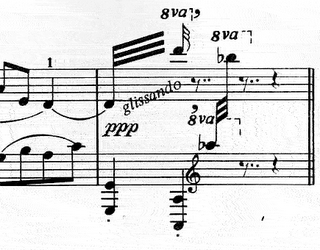
I knew this was going to be trouble, but I also knew that nothing is impossible with Finale, (I wouldn't make that claim with Sibelius). Some of the difficulties were foreseen, such as the missing 32nd note, but there were some other surprising complications. For instance, the glissando word by itself does not come standard in smart shapes, and the cross-staved notes were a little tricky. But I got it, in under an hour. Test your chops, see how fast you can do it... Or just follow the instructions below:
1. Speedy Entry:
Speedy entry menu: check for extra notes to off
top staff 32 note D, 32nd note D octave up, dotted eighth rest (hidden), another 32nd note (high D) double dotted eighth rest
hide the dotted eighth rest (H), flip the high D (L)
bottom staff octave up, quarter, quarter, 32nd rest, double dotted eighth rest, quarter rest
2. Note Mover
note mover menu, choose "cross staff"
throw the a-flat down to the bottom staff
3. Special Tools -
reverse stem: flip the note on its stem in the second group of 32nds
beam angle: tweak the beams on both 32nd note sets
note shape: choose 202 for the note shape on the second 32nd note to hide it.
custom stem: choose 66 to hide the stem
4. Clef tool
double click in the bottom staff
choose create movable mid-measure clef
5. Smart Tools
option click the custom smart tool
duplicate the glissando with the wavy line
edit your duplicate
in the "Line Style" "Character" box, delete the tilda (~)
draw the glissando and tweak the placement
add the 8va's
6. add the breath marks using the Articulation tool (#36)
7. Tweak the spacing using Speedy entry and/or the Measure tool

I knew this was going to be trouble, but I also knew that nothing is impossible with Finale, (I wouldn't make that claim with Sibelius). Some of the difficulties were foreseen, such as the missing 32nd note, but there were some other surprising complications. For instance, the glissando word by itself does not come standard in smart shapes, and the cross-staved notes were a little tricky. But I got it, in under an hour. Test your chops, see how fast you can do it... Or just follow the instructions below:
1. Speedy Entry:
Speedy entry menu: check for extra notes to off
top staff 32 note D, 32nd note D octave up, dotted eighth rest (hidden), another 32nd note (high D) double dotted eighth rest
hide the dotted eighth rest (H), flip the high D (L)
bottom staff octave up, quarter, quarter, 32nd rest, double dotted eighth rest, quarter rest
2. Note Mover
note mover menu, choose "cross staff"
throw the a-flat down to the bottom staff
3. Special Tools -
reverse stem: flip the note on its stem in the second group of 32nds
beam angle: tweak the beams on both 32nd note sets
note shape: choose 202 for the note shape on the second 32nd note to hide it.
custom stem: choose 66 to hide the stem
4. Clef tool
double click in the bottom staff
choose create movable mid-measure clef
5. Smart Tools
option click the custom smart tool
duplicate the glissando with the wavy line
edit your duplicate
in the "Line Style" "Character" box, delete the tilda (~)
draw the glissando and tweak the placement
add the 8va's
6. add the breath marks using the Articulation tool (#36)
7. Tweak the spacing using Speedy entry and/or the Measure tool
9.03.2006
Transitions are never easy
So it has been awhile, starting a new job, been busy, yadda-yadda...
Anyway I'm back, I'll try blogging again semi-regularly... um.. weekly maybe.
The new job:
My predecessor, Josh was still around part-time for two weeks to get me oriented with the system and the many varied duties. We also had some goals to accomplish when I arrived: transition to the newly updated Mac server, make live the new department website, connect to the campus LDAP system. Unfortunately we weren't able to do these until the last day (afternoon) that Josh was there.
You've heard that it is surprisingly easy to fly a plane once it is in the air and cruising; it is the taking off, landing, and other troublesome maneuvers that require all that time and money in flight school. Well, somehow the LDAP binding maneuver wiped out the users on the server. So while I thought I'd have time to study and tweak the system ever so cautiously, I found myself throwing levers in the cockpit and wildly making adjustments in mid-flight, meanwhile speaking calmly in the microphone to the passengers, uh.. don't be alarmed, I will have things back up and running shortly.
I exaggerate. But that is close to how I felt. The first week I was at school eleven or twelve hours a day plus working well towards midnight from home, but I now feel like things are back to normal and I can start working on the things I have been putting off for two weeks (like sleep... and blogging).
Anyway I'm back, I'll try blogging again semi-regularly... um.. weekly maybe.
The new job:
My predecessor, Josh was still around part-time for two weeks to get me oriented with the system and the many varied duties. We also had some goals to accomplish when I arrived: transition to the newly updated Mac server, make live the new department website, connect to the campus LDAP system. Unfortunately we weren't able to do these until the last day (afternoon) that Josh was there.
You've heard that it is surprisingly easy to fly a plane once it is in the air and cruising; it is the taking off, landing, and other troublesome maneuvers that require all that time and money in flight school. Well, somehow the LDAP binding maneuver wiped out the users on the server. So while I thought I'd have time to study and tweak the system ever so cautiously, I found myself throwing levers in the cockpit and wildly making adjustments in mid-flight, meanwhile speaking calmly in the microphone to the passengers, uh.. don't be alarmed, I will have things back up and running shortly.
I exaggerate. But that is close to how I felt. The first week I was at school eleven or twelve hours a day plus working well towards midnight from home, but I now feel like things are back to normal and I can start working on the things I have been putting off for two weeks (like sleep... and blogging).
Subscribe to:
Posts (Atom)